
GAC Honors President Boakai for Creating Enabling Audit Environment Void of Political Interference
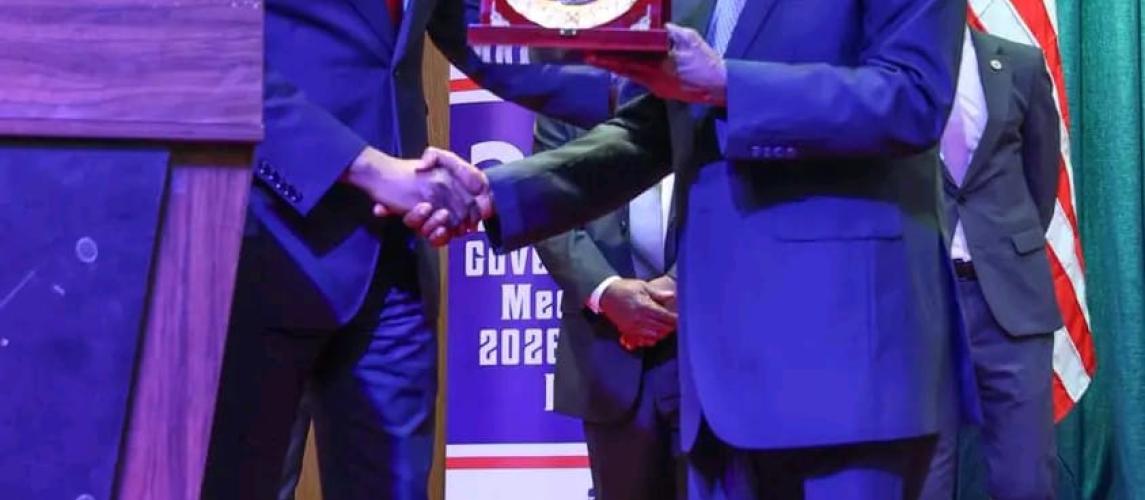
The Auditor General averred that President Boakai demonstrated commitment to accountability, transparency, and institutional independence, which strengthened governance, when he commissioned an “Audit” of the “Office of the Presidency” and other key organs of Government.
Liberia's Auditor General, the Honorable P. Garswa Jackson Sr., bestowed the honor upon the President at the official opening of the ongoing 22nd Governing and 2026 Strategic Review of African Organization of English-Speaking Supreme Audit Institutions—AFROSAI-E, on Wednesday, May 20, 2026, at the Ellen Johnson Sirleaf Ministerial Complex in Monrovia.
The ongoing AFROSAI-E 22nd Governing Board Meeting and 2026 Strategic Review in Monrovia brings together twenty-six (26) member Supreme Audit Institutions (SAIs) of English-speaking African countries, along with development partners, to review progress on the 2025–2029 strategic plan, strengthen institutional capacity, and deepen cooperation on public financial management, audit quality, and independence of audit institutions through improving transparency, accountability, and governance and sharing audit experiences, assessing reforms, and reinforcing peer learning mechanisms that help Supreme Audit Institutions better detect misuse of public resources and enhance service delivery to citizens across Africa.
The GAC recalled that, over the years, Liberia experienced the costs of weak accountability and weakened governance across every sector as a country. But with the power of strong reforms demonstrated by the Boakai’s Administration, the General Auditing Commission, which is the Supreme Auditing Institution of Liberia, has shown strong leadership, collaborative teamwork with prestigious networks, carried out several reform activities that reaffirmed its role as a pillar of accountability in Liberia.
The GAC lauded the Administration of President Boakai for making and implementing strong commitments that review and address dual-sided budgetary challenges. Honorable Jackson revealed that the Government of Liberia, through the Ministry of Finance and Development Planning, has disbursed 50% of the approved budget to the commission, consistent with the GEC Act of 2014. An act the commissioner says is happening “for the very first time since its passage.”
He said, over the past four years, the GAC has extended audit coverage and regularized audits of consolidated funds and national statements. Adding that it has also performed a number of country-presidential audits, including audits of the Office of the President and Ministries of State, audits of the National Legislature, the judicial branch of government, and audits of the Central Bank of Liberia.
The Auditor General said, although these audits reported significant discrepancies and irregularities, the audits demonstrate that the Government has a stance with clear indications that no public official or public office is immune from accountability over the stewardship and use of public resources in Liberia.
He furthered that the Government also commissioned other highly impactful audits - including civil service payroll audits, which automated and initiated major reforms in the processing and disbursement of government monthly payroll. Honorable Jackson reported that these reforms saved the government millions of United States dollars through the implementation of audit recommendations and desk audit measures.
He added that the most recent published report in 2025 identified unsupported claims in excess of $704 million, resulting in potential savings that can be redirected toward poverty reduction projects. Additionally, the GAC added the newly published revenue systems and reconciliation audits, when recommendations are implemented, can facilitate more comprehensive and accurate revenue generation and reporting, thereby significantly increasing national budget efficiency.
Honorable Jackson added that the Government implementation of audit recommendations increased from a baseline of 13% in 2024 to 37% in 2025, with some ministries, agencies, and commissions averaging between 90% and 93% implementation. He stated that these improvements have resulted in stronger internal controls, better compliance with laws and regulations across government, and ultimately improved service delivery to Liberians.
